
In this article, we explore how different educational cultures operationalize the CCC, from validating workplace-based assessments to creating dedicated space for holistic ‘gut feeling’ and expert intuition. And why combining these approaches gives room for a resilient assessment culture.
Across international medical education frameworks, the Clinical Competency Committee (CCC) plays an indisputable role in high-stakes assessment and entrustment decisions.
However, a deeper look at global practices reveals two distinct approaches to how the CCC actually functions alongside workplace-based assessments (WBAs). While some international systems position the CCC primarily as a validation body for existing WBA data, other systems, most notably in Dutch medical training, utilize the committee as a vital supplementary source that captures tacit knowledge, professional intuition, and unmeasured aspects of competence.
Let’s explore how these two approaches operate in daily practice and why combining them creates a far more resilient assessment culture.
Approach 1: The CCC as a validation mechanism for WBAs
In many international competency-based models, the CCC functions primarily as a high-level review panel.
Within this framework, workplace-based assessments, such as direct observations, mini-CEXs, and workplace feedback, are the core building blocks. Clinical trainers log these assessments during daily practice to capture a trainee’s progress across clinical rotations.
The committee’s main job is to bring all these data points together. The CCC reviews the complete picture to check whether the accumulated evidence shows a consistent and dependable trajectory toward autonomy.
To protect the standards of the program, this approach focuses on:
- Quality assurance: Ensuring that individual trainer leniency or a few isolated observations do not distort the final entrustment decision.
- Data synthesis: Translating dozens of separate workplace notes into a formal, structured entrustment decision.
- Auditability: Building an objective, evidence-backed portfolio that clearly aligns with program standards
In short, the committee acts as an objective quality filter: ensuring that high-stakes decisions are grounded in solid, verifiable workplace data.

Approach 2: The CCC as a source of supplementary insight and ‘gut feeling’
By contrast, Dutch medical training programs view the CCC through a broader, more dynamic lens. This approach recognizes a practical truth of daily clinical care: standard WBA forms on a busy ward simply cannot capture every nuanced interaction, professional attitude, or subtle growth trajectory.
Here, the CCC acts as an active source of qualitative insight rather than just a passive reviewer of submitted paperwork.
The committee creates a dedicated space for faculty members to share longitudinal observations, implicit judgments, and professional “gut feeling”, what educators call expert intuition.
This supplementary approach allows the committee to bring essential, unwritten evidence into the room:
- Unspoken concerns: Surfacing subtle doubts about a trainee’s clinical judgment that were never formally written down after a hectic shift.
- Unrecorded excellence: Recognizing exceptional capability or professional maturity that falls outside standard checklist metrics.
- Collective contextualization: Using group discussion to ground individual intuition in concrete examples, turning a vague feeling into clear feedback.
Rather than treating professional intuition as subjective bias to be eliminated, this approach uses the collective wisdom of the committee to transform unspoken observations into actionable guidance.

The power of combining both approaches in EPA-based medical education
Rather than viewing these two approaches as mutually exclusive, modern EPA-based education works best when they go hand in hand.
The validation approach brings essential rigor, consistency, and alignment with overall program standards. At the same time, the supplementary approach ensures that human nuance, subtle safety concerns, and qualitative professional growth aren’t overlooked just because they didn’t make it onto an assessment form.
When combined, the CCC transforms from a passive audit panel into a dynamic diagnostic forum. It validates what has been explicitly logged on the floor through workplace-based assessments, while providing the safety net of collective wisdom to capture everything beyond the numbers.
Streamline your entrustment process with our CCC-feature
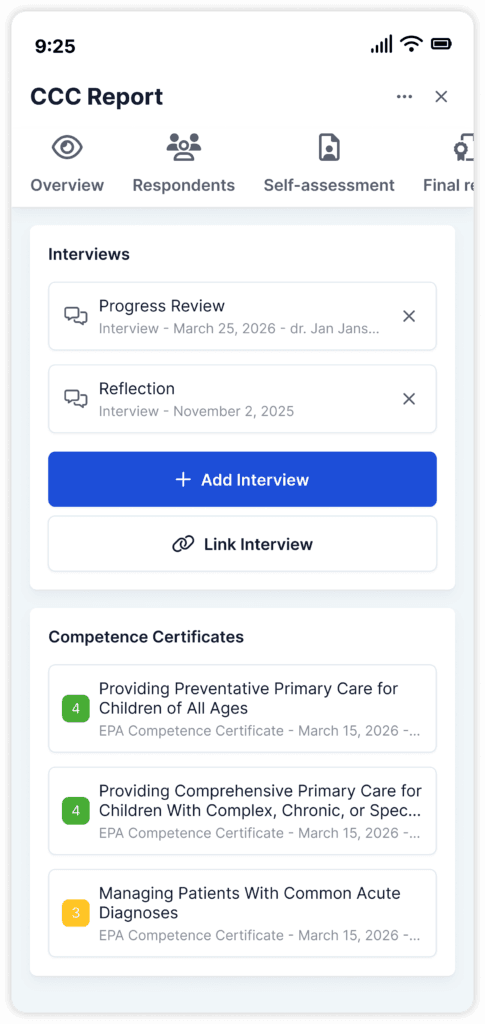
Rather than forcing you to choose, The CCC-feature in the Reconcept EPA Portfolio is built to capture both approaches .
- Centralizing WBA data: The platform automatically gathers all completed assessments, trainer notes, and progress metrics, making the validation of logged evidence fast and reliable.
- Capturing qualitative input: Alongside the numbers, it offers a structured space to document longitudinal observations, voice subtle concerns, and share professional intuition.
- Streamlining the final decision: Committee members can review the full picture and formally update the trainee’s entrustment outcome.
By bringing all workplace observations together into one seamless workflow, our platform helps your committee make confident, defensible entrustment decisions.

Discover our EPA learning hub
Webinars, articles, e-books and much more on the topic of EPA-based Medical Education.

Subscribe to the EPA Portfolio Newsletter
Stay on top of our newest Blogs and Updates by subscribing to our newsletter!

- Two approaches to the Clinical Competency Committee: Validation vs. Supplementary Insight – 07-31-2026
- The Role of the Clinical Competency Committee in EPA-Based Learning – 07-23-2026
- The evolution of postgraduate medical education: Integrating EPAs into European Training Requirements (ETRs) – 04-10-2026