

In a previous article, we explored how EPAs and Milestones complement each other: EPAs provide a holistic view of trust (Entrustment), while Milestones serve as the granular building blocks of competence. However, the biggest challenge in practice is the administrative burden. How do you track progress on dozens of Milestones without requiring trainers to check hundreds of boxes? The answer lies in smart automation within the Reconcept EPA portfolio.
When a trainer assesses a trainee during a workplace-based assessment (WBA), such as a Mini-CEX or DOPS, the focus is on clinical practice. The trainer provides a judgment on the level of supervision required for that specific task at that specific moment. Yet, behind that single task lie multiple underlying competencies: the Milestones.
Bridging the gap between observation and administration
Traditionally, trainees or faculty members had to manually map which Milestones were achieved after each assessment. This process is not only time-consuming but also prone to “check-box fatigue,” where Milestones become a clerical task rather than a reflection of genuine growth.
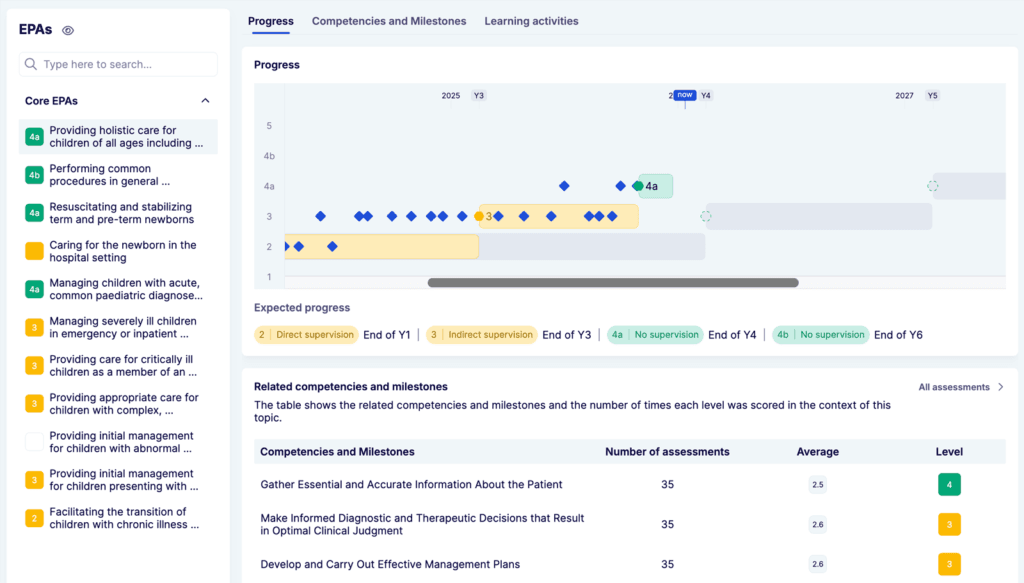
In the Reconcept EPA portfolio, we bridge this gap by linking the indicative EPA level recorded in a formative instrument (WBA) directly to the underlying Milestones.
How it Works: automated translation
The principle is simple yet powerful: one observation, multiple data points.
- The mapping: In the portfolio setup, each EPA is pre-mapped to its relevant Milestones (for example, based on the CanMEDS framework).
- The assessment: During a WBA, the trainers scores the trainee on a Level of Entrustment (e.g., “Level 3: May perform under indirect supervision”).
- The automation: The system recognizes which competence level corresponds to this entrustment score and automatically populates the linked Milestones.
Because the Milestones are “fed” by the formative data from daily practice, the trainer never has to score individual Milestones manually. The data is updated in the background based on holistic, real-world feedback.
Why this enhances educational quality
Automating Milestone scores provides three major advantages for postgraduate medical education:
- Reduced administrative burden: trainers can focus on what they do best: providing qualitative feedback and coaching, rather than navigating complex competency frameworks.
- Objective trend Lines: Because scores are derived consistently from concrete workplace assessments, a more reliable picture of development emerges over time. You see patterns of growth rather than isolated snapshots.
- Evidence for the Clinical Competence Committee (CCC): When a trainee approaches a formal entrustment decision (summative entrustment), the CCC has immediate access to the underlying Milestone data. They can verify if and how specific competency domains have developed, without any extra data entry required from the faculty.

Balancing automation and human judgment
While automation relieves the burden on the trainee and trainers, the human dialogue remains essential. The system provides a data-driven suggestion (“The trainee appears to be at this level for Communication”), but the final interpretation occurs during the Clinical Competence Committee (CCC meeting).
Technology serves as the foundation: gathering the evidence so that the users can focus on the essence of medical training: learning through practice.
Conclusion
Integrating EPAs and Milestones is the first step toward a modern curriculum. The next step is making that model sustainable. By allowing Milestone scores to be generated automatically from daily formative instruments, we make development visible without increasing the workload.
Want to see how this works in practice? Within the Reconcept EPA portfolio, this logic is fully integrated. We would be happy to show you how the connection between WBAs, EPA levels, and Milestones can support your training program.

- Two approaches to the Clinical Competency Committee: Validation vs. Supplementary Insight – 07-31-2026
- The Role of the Clinical Competency Committee in EPA-Based Learning – 07-23-2026
- The evolution of postgraduate medical education: Integrating EPAs into European Training Requirements (ETRs) – 04-10-2026