

Competency-based medical education increasingly relies on tools that make learner progress visible and defensible. Two of the most widely used instruments are Entrustable Professional Activities (EPAs) and milestones. While they are often implemented side by side, their true strength lies in meaningful integration. When used together, EPAs and milestones support both sound assessment decisions and continuous learner development.
EPAs and milestones: complementary perspectives
EPAs describe units of professional practice that learners must be able to perform in real clinical or professional contexts. Assessment of EPAs focuses on entrustment: to what extent can a learner perform an activity independently, with supervision, or not yet safely at all? As such, EPA decisions are holistic, context-dependent, and typically summative in nature.
Milestones, by contrast, describe developmental stages within competencies. They articulate how a learner progresses over time, often across domains such as communication, professionalism, or clinical reasoning. Milestones are more analytical and longitudinal, making them particularly valuable for formative feedback and tracking growth.
In short, EPAs answer the question: “Can this learner be entrusted with this activity?”
Milestones answer: “How has the learner developed to reach this point?
One evidence base, different assessment scales
A frequent source of confusion lies in the different assessment scales used by EPAs and milestones.
EPA assessments typically use entrustment-based scales, for example ranging from observation only, to indirect supervision, to independent practice. These scales support high-stakes decisions and reflect real-world responsibility.
Example entrustment-based scale
1. Observation
2. Direct supervision
3. Indirect supervision
4. No supervision
5. Supervising others
Milestones, on the other hand, use developmental scales, such as deficient to expert. These scales describe progression and are well suited for detailed feedback and coaching conversations.
Example developmental scale
1. Deficient
2. Early learner
3. Advancing
4. Unsupervised
5. Expert
Although the scales differ, they are often informed by the same workplace-based evidence: observations, feedback, and performance data. Integration ensures that evidence collected for learning also supports decision-making, rather than creating parallel or redundant assessment processes.
How EPAs and milestones reinforce each other
EPAs are rarely linked to a single competency. Instead, each EPA draws on multiple competencies, each of which can be described using milestones. Milestones therefore help explain why a learner can (or cannot yet) be entrusted with an EPA.
For example, an EPA decision may indicate that a learner requires indirect supervision. The associated milestone data can reveal whether this is due to communication skills, clinical reasoning, or professionalism. This added transparency benefits learners, supervisors, and assessment committees alike.

Assessment in practice
In practice, milestones are often used formatively. They guide feedback, coaching, and reflection, helping learners understand where they stand and what their next steps are. EPAs, supported by this milestone evidence, enable more robust summative decisions.
When milestones and EPAs are aligned, assessment becomes both educationally meaningful and defensible. Learners receive clearer feedback, and assessors can justify entrustment decisions based on documented development rather than isolated impressions.

Conclusion
The take-away to remember is that EPAs and milestones serve different purposes, but they are most powerful when used together. EPAs provide clarity about professional readiness, while milestones make development visible and actionable. Integrating both, conceptually and digitally, bridges the gap between learning and assessment, supporting fair decisions and meaningful growth.

Digital integration: bringing EPAs and milestones together in one system
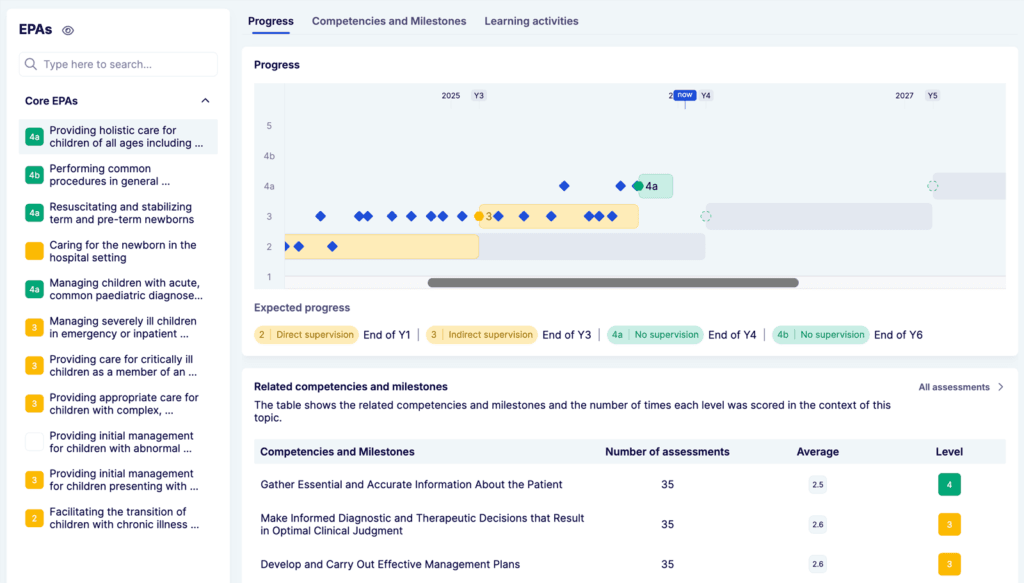
Both EPAs and milestones are integrated within the Reconcept EPA Portfolio. EPAs are directly linked to their underlying milestones, allowing users to move seamlessly between holistic entrustment decisions and detailed developmental insights.
The image below shows a selected EPA with its associated milestones, current milestone levels, and the resulting entrustment decision. This integrated view helps learners understand how their development translates into responsibility, and helps assessors substantiate their judgments.By presenting EPAs and milestones together, Reconcept EPA Portfolio reduces fragmentation and supports consistent use across formative and summative assessment.

- Two approaches to the Clinical Competency Committee: Validation vs. Supplementary Insight – 07-31-2026
- The Role of the Clinical Competency Committee in EPA-Based Learning – 07-23-2026
- The evolution of postgraduate medical education: Integrating EPAs into European Training Requirements (ETRs) – 04-10-2026